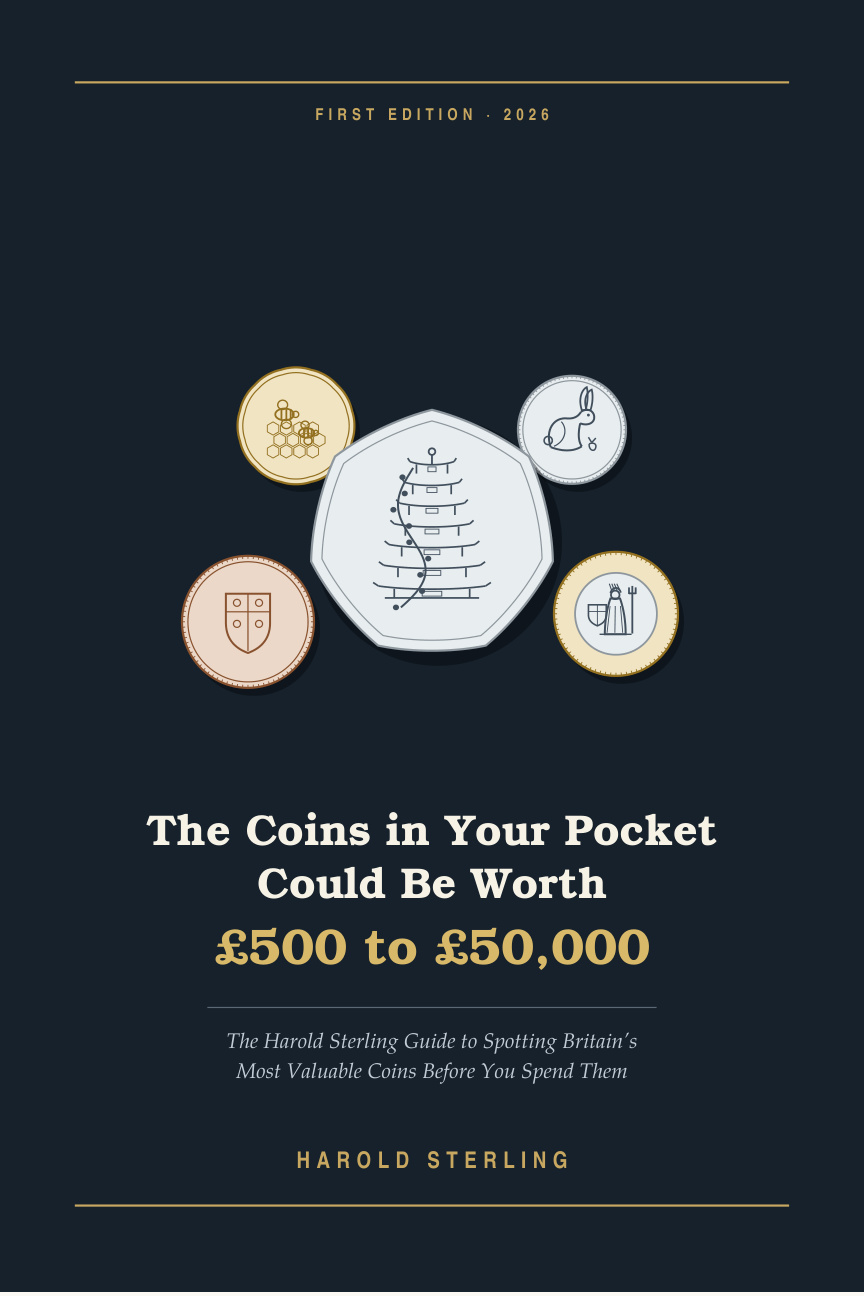
The complete guide to spotting Britain's most valuable coins before you spend them — which coins in your house are worth more than their face value, how to tell them apart from the ordinary ones, and what they have actually sold for.
Instant download · Yours forever

“Most coins are worth exactly what it says on them. That is not a disclaimer. It is the single most useful fact in coin collecting.”
— Harold Sterling, page oneThere are excellent histories of British coinage. This is not one of them. This book has a narrower job.

I have spent a little over thirty years around British coins. Some of that behind a counter, a good deal of it at the Midland fair in Solihull and the London fairs before that, and rather more of it lately in front of a camera.
The questions people bring me have not changed in three decades. Is this one rare. Is that a mistake or just damage. Somebody told me this was worth a thousand pounds, is it. The answers have not changed much either, and they are almost all in this book.
Some of what follows has appeared on the channel. Most of it goes considerably further than a video ever can, because a video has to hold your attention for eight minutes and a book can simply tell you the truth and let you take your time over it. A few chapters are not on the channel at all.
Where a coin is genuinely rare, I say so and give you the figures. Where a coin is being talked up online and is not rare at all, I say that too, and I name it. There are a number of stories doing the rounds that have cost people real money, and a book that repeated them to keep you excited would not be worth the price of it.
Every chapter is built the same way. The coin itself and why it matters. How to identify it, written the way I would talk you through it if the coin were on the counter between us. Then the figures — how many were made, and what examples have actually sold for, broken down by condition. Then what people get wrong about that coin, which is usually the most valuable part. Then what to do if you have one.
Nearly every expensive miss I have seen over the counter happened the same way.
Read them in any order that suits you. The contents group by denomination — if the jar on your windowsill is mostly fifty pences, start there.
Instant download · Yours forever
What readers write in after their first pass through the jar.
“Did the ten-minute check on the biscuit tin in the hall while the kettle boiled. Two 2011 sport fifties and one I'd never have looked twice at. The book paid for itself before I'd got to Chapter 3.”
Margaret H.Derbyshire“I nearly gave a coin a good clean last year because it looked grubby. After Chapter 21 I understand what that would have cost me. Wish I'd read this in 2019.”
Dennis W.Kent“What I wanted was somebody to tell me plainly which coins are talked up and which are actually scarce. Harold names them. My grandson and I now check the change together every Sunday.”
Pauline R.Ayrshire
Thirty-odd years around British coins. Some of it behind a counter, a good deal of it at the Midland fair in Solihull and the London fairs before that, and rather more of it lately in front of a camera.
I am not a historian and I do not pretend to be. What I know is the practical end of it: which coin in a handful is worth a second look, how to tell a genuine minting error from a coin that has simply had a hard life in a till, and what things actually sell for rather than what people ask.
I wrote this book for everyone who has ever tipped out a jar of coppers on the kitchen table just to see what was in there — and for everyone who has spent a valuable coin without knowing it, which is very nearly all of us.
The complete First Edition, delivered the moment you order.
Launch price · ends at midnight
Get Instant Access — $27Instant download · Yours forever
Visa · Mastercard · Amex · PayPal · Apple Pay
Every price in the book is what a coin has actually sold for, not what somebody is asking for one. The difference between those two numbers is the single largest source of disappointment in this hobby, and Chapter 22 is devoted entirely to it.
Mintage figures are those published by the Royal Mint, cross-checked against independently compiled circulation data. Values reflect the market up to the middle of 2026. Treat them as a sense of scale — is this a five-pound coin, a fifty-pound coin, or a five-hundred-pound coin — and check the live figure before any transaction. Chapter 22 shows you how, free, in a couple of minutes.
Because a video has to hold your attention for eight minutes, and a book can simply tell you the truth and let you take your time over it. Most of what is in here goes considerably further than a video ever can, and a few chapters are not on the channel at all.
The channel shows you one coin. The book gives you the method for every coin in the jar, plus the mintage tables, the grading, the selling routes and the check card, all in one place you can keep.
Because the people who most need this book are the ones with a jar on the windowsill they have never properly looked at, and I would rather they read it than admire the price of it. $47 is what a guide of this length ordinarily goes for. $27 is the launch price while the First Edition is new.
No, and anybody who tells you otherwise is selling you something worse than a book. Most coins are worth exactly what it says on them — that is the single most useful fact in coin collecting, and the reason the exceptions matter so much. If every 50p were valuable, none of them would be.
What the book gives you is the ability to know, in about ten minutes, whether a given handful of change contains anything worth a second look — and to stop spending the ones that do.
A 147-page PDF. You get the download link the moment you order — no waiting for the post. Read it on a phone, a tablet or a computer, or print it at home. The One-Page Check Card is designed to be printed and kept next to the coin jar.
It is written for the opposite of a collector. It assumes no jargon, no equipment beyond a lamp and a tea towel, and no prior interest in coins — only a jar, a tin or a drawer and some curiosity about what is in it. Chapter 18 covers grading without the jargon; the glossary handles the rest.
Yes. Modern British circulating coinage — fifty pences, round and twelve-sided pounds, two pounds, twenty pences, twopences and pennies, plus the pre-decimal silver that still turns up in houses. Every figure is in pounds sterling. If your change is not British, this is not the book for you.
Wait — one thing
Less than one takeaway. The Atlantic Salmon 50p in Chapter 1 has sold for £50 to £90 — and two hundred thousand of them went into circulation.
Get the Book — $27 or see what's inside →